Why Rejection Makes You a Better Writer

Death ValleyJodi

After a few weeks querying agents for my YA book, I needed to take a break and consider my progress. One agent, who I met and worked with in a critique group, sent me a personal rejection the same day I emailed her. Another agent, who loved the book at a retreat, sent me back her regrets. In prior years, with prior books, I would get no rejection letter at all. Only silence. Compared to no response, my recent rejections have led me to be more optimistic.

So I decided to make a list of how agent (and magazine editor) rejections have improved my writing:

  1. Book rejections make you realize that you need feedback on your writing before you send it out to agents.

 When I began my writer’s journey, I finished my rough draft and thought I had a masterpiece. I read a little of it to my friends, but I was sure that it was finished. Now I enlist the aid of critique groups, professional editors (not as expensive as you would think), writing retreats, and college extension classes before I send anything out.

  1. Agents have their own agendas.

They actually have to sell your book to publishers, who are even more jaded than they are. Agents have categories of books that they represent. If they already have enough magic books, they won’t be interested in your fantasy project. The lesson here is keep querying. You just haven’t met your agent yet.

  1. Being rejected by agents can lead to personal growth in your writing.

After getting several rejections on a book, I looked at all the comments that accompanied the passes. Agents are busy people, and if they take the time to tell me what they didn’t like about my work, I need to pay attention. This has led me to take writing classes at UCLA Extension, which I highly recommend. I also began submitting short stories to magazines so I could beef up my publishing credits.

  1. I appreciate all the hard work that goes into the books I read.

I read all the acknowledgments at the back of the novels I read, and count the number of people the author thanks. Have I exposed my WIP to that many people? Also, I was encouraged by an writer that had the courage to admit she had 17 novels rejected before she was published. Therefore, I need to stop my whining.

  1. Rejection makes me recommit to writing.

As the years pass, it would be easy to turn off the laptop and do something else with tangible results, like knitting. Writing is easy, revision is hard, traditional publishing seems nearly impossible. However, I’ve overcome many impossibilities in my life, and I’m not ready to die to my dreams yet. Rejection shows me that I haven’t reached that mountain peak— I’m still in the foothills. I need to keep walking.

  1. Rejection initiates me into the writing community.

All writers experience rejection at some time, and they can be a great source of encouragement to other writers. Joining Twitter and following other writers allows me to share in their joy and pain along the publishing path. Thanks, guys.


As you can see, rejection is not as negative as the gut punch you feel at first when you open that agent’s email reply. You get mad, cry a little, eat chocolate, drink a large glass of wine, and get back to work. And hopefully, after a lot more work, someday we’ll be sitting by the pool reading each other’s novels instead of this blog.

How three writing workshops and NaNoWriMo saved me from a two month writing drought

Me beach

Sitting down with my hot eggnog, Christmas music playing in the background, I noticed on my webpage that this is the first blog I’ve written since the beginning of September. How did that happen?

After writing every day and producing a nine episode novella during the summer, I started the school year knowing that teaching would drain my creative time, but remained undaunted as I signed up for three writing workshops at the end of September. When I opened my front door every day after school, my brain was mush and I had nothing to write. My husband and I were even too busy to catch many HOG chapter Harley rides, so I did not even have any Harley ride tales to share. I was certain that hearing about successful writing would motivate me to press on.

The Inland Empire California Writers Club held their Fall Retreat in Idyllwild, a tiny mountain community, the perfect place to get away and write. One of the workshops focused on marketing. I didn’t realize that I needed to work on a press kit before my book was published. After the retreat, I had time to write in my cabin in front of the fireplace. It was fun to entertain fresh ideas and characters after spending years on College of the Crones. After writing, polishing, and submitting that three-year project, I needed to turn my attention elsewhere. Waiting for the next query rejection is a dismal way to spend your time.

Next came a one-day workshop up in Hesperia called “The 90 Day Novel” with Alan Watt, from the L.A. Writers Lab. Alan became my characters’ psychologist, as he helped each of us to draw out the backstories and motivations that would make my story ring true. Although it was an intense day with a small group of writers, I came home with a greater sense of who my characters were and how they would react in different situations.

The last writing conference, held the first Saturday in October, was The Society of Children’s Book Writers and Illustrators Meet the Editors Day at Cal State Fullerton. Editors and agents talked about the publishing industry. I had the opportunity to have lunch with one of our speakers, a writer from Redlands. We talked about the importance of revisions, critique groups, and a finding an editor.

After all that input, you might think that I would rush back to my laptop and start writing. I certainly thought that on the way home. Unfortunately, school and Harley riding and my social life conspired to eat up October until I found myself with no word count, or blog at Halloween. Scary, right?

So what does a girl do? Join NaNoWriMo of course! That stands for the National Novel Writing Month. On their website, you pledge to write 50,000 words during the month of November. I took my story ideas from Idyllwild, my characters and scene outline from the Alan Watt workshop, and my dreams about publishing from the Meet the Editors Day and plunged into the deep end of my new novel. The first chapters flowed, and when I posted my daily word counts, my numbers matched the trajectory on the graph I needed to get to my goal.

Then came the three day Harley ride with my husband and our HOG chapter up to San Simeon over Veterans Day weekend. No room for my laptop on the bike. And don’t forget Thanksgiving, which stole away a few more days of writing.  I found myself in the last week of November with 15,000 more words to write.

Hard words, too. After my initial flurry through my outline, I reached the end of my story, but still too brief to be classified a real novel. I rewrote my outline, based on what I had actually written, and looked for places that needed more structural support.  Should Star go on two dates with Frank before breaking up with him instead of one? Would her friends call a meeting to confront her about hanging out with their evil magician friend?

Bit by bit I gained on my word count, 1800 to 3000 words a day. The last day of November, I still had 1500 words left. Bleary-eyed, I shooed away my husband and my Pomeranian, and pounded away on the keys.

At 9:38 p.m., I made it! A brand new rough draft of a novel, done in thirty days. Redemption for my wasted autumn.

Of course, the book, titled The Spellwriters Book Club, is not finished. Months of revisions, critique groups, and editing stretch before me.

But my writing drought is over, thanks to three writing workshops and NaNoWriMo.

Finding Gold in My Story

snow


A weekend in the mountains sounds restful, but for the twenty five writers that attended the Southern California Society of Children’s Book Writers and Illustrators Spring Retreat in Idyllwild, it turned out to be three days of hard work. The focus was on middle grade and young adult works in progress, which placed me in the company of my genre peers, rather than in the mixed company of most critique groups I had attended.

For me it was the last effort I was willing to extend toward a project I had been writing for three years. A book that I had thought I had finished, but had been quietly rejected by agents for the past two years. The College of the Crones had sat unloved in my document files, while my creative nonfiction articles were getting snapped up by travel journals. The first time I’d thought the book was finished, I spent worthwhile money on professional editing. I had even pitched my book to an agent at a writing conference, and took her advice to heart, getting rid of one of my main characters. But I was tired of working without result. The title of the retreat was “Finding Gold,” but I wasn’t sure that my book had anything valuable left.

The dream team of masterminds behind the weekend included Heather Buchta, who organized a group of writers who mostly had never met each other into focused critique groups. A few weeks before I headed up the mountain, Heather emailed our group with a request to share our photo and synopsis of the work we were planning to share. This proved to be brilliant, as we knew who to look for when we arrived. Also we didn’t have to spend a lot of time getting our group up to speed on our stories.

Although I had attended previous writing conferences, this one proved to be the most productive. We had four sessions of critiques with our small group of six and our leader. In addition, an agent, editor, or published author would also sit in with us. Each writer had fifteen minutes during each session to use as they wished, timed by our leader. Some writers read different chapters each session, while others took the feedback and revised the same passage, printing out copies for the group on the printers that some of the leaders brought with them.

Between critique sessions, Kate Sullivan, senior editor at Delacorte Press, and Erin Young, agent at Dystel, Goderich and Bourret, gave brief, useful presentations on theme, query letters, and pitches. Estelle Laure and Steve Bramucci, published authors, told their tales about being in the trenches as writers. These session drew laughs as well as tears, and plenty of “ah-ha!” moments.

But I will always treasure Kate and Estelle contributing to my critique group. They set a high bar for courtesy and professionalism. And I will never forget the passion and meticulous attention they showed toward my manuscript. Priceless.

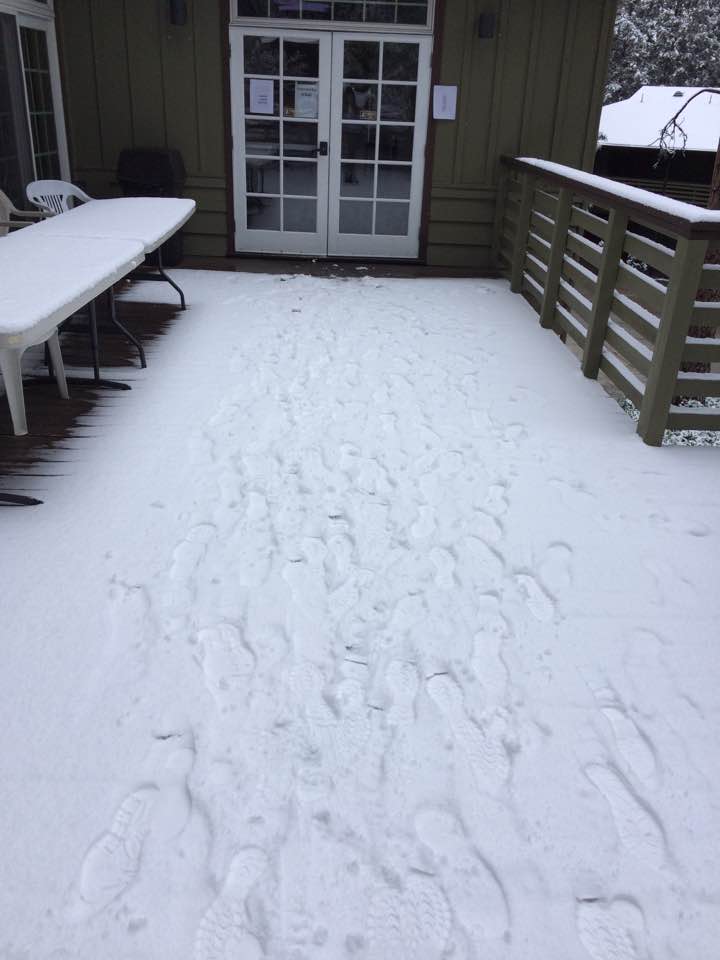
Hikes and writing time were built into our schedule, which provided additional time to share with other writers. Wine and appetizers in front of a roaring fire at a nearby restaurant made us feel like we were in a story. The weather became a main character over the weekend, as we changed from sunny spring weather on Friday to a Sunday morning blanket of snow.

All weekend long, I cherished each stolen moment to revise a few more chapters. With the help of one of the leaders, I reprinted two chapters that I reworked after the first two critique sessions. I worked with a feverish zeal that reminded me of my rough draft days. It was hard to put my computer away.

Suddenly, it was Sunday morning and time for awards. If we chose, we could have submitted our first ten pages for a contest a month before the retreat. A team of published writers and editors judged the manuscripts in a blind contest. The two categories of middle grade and young adult were judged separately, with first place and honorable mention in each. As the leaders announced the young adult winners, I hoped that someone from my critique group would win since the quality of the work shared had been excellent. What I wasn’t prepared for was when they called my name for honorable mention.

As I stood up to receive my certificate in a daze, I realized that my book, almost abandoned for the immediate gratification of shorter articles, deserved to live. The College of the Crones would be finished, but with new direction and inspiration.

After lunch, I headed down the mountain through a snowstorm, eager to get home and continue revisions on my book. Instead of rocks, I had found the gold hidden in my story. If you ever have the opportunity to attend a writing retreat for works in progress, don’t hesitate to sign up. It turned out to be a weekend I will always treasure.


On being published, and how it changed my life

i-am-a-writer

Two years ago, I got sick and tired of my pathetic longing to publish my novel. My book project was only one year into the revised drafts, and I felt like time was running out. Let’s face it –I’m not getting any younger, and if I want to be a best-selling author I need to get my first one on the New York Times bestseller list. So I sent out an army of queries to any agent that represented my genre. My submission spreadsheet grew into several pages with polite rejection notes. The agent I met at a very expensive writer’s conference never responded to my query. I was desperate for a new approach.

My critique group was supportive and gave great feedback, but they were not professionals in the writing industry. I wasn’t going to improve my writing without higher standards. Should I go back to school? Seeking to improve my craft, I enrolled in a local university’s online creative writing program. What I expected was that my writing would be pulled apart, equipped with upgrades, and become the shiny sports car I needed to catch a literary agent’s eye. What I experienced was a barrage of articles about writing that I could have Google searched myself. The students provided feedback on each other’s assignments, although most were not qualified or bold enough to give more than vague compliments. Curiously absent were concrete suggestions from the teacher. Although it was great to have structure and deadlines for creating short pieces, I didn’t really learn anything new.

However I did enjoy discussing the art of writing with other people interested in pursuing a writer’s life. There had to be other writers out there like me that wanted to be taken seriously. So I searched the internet and found the California Writers Club. It was a state club with local branches, so I checked out the Inland Empire Branch. What an exciting moment when I walked into a room with thirty other writers, most full time professional ones, and listened to a presentation about marketing books on social media. These people were living the life I dreamed about! I joined the group, and the members have become some of my dearest encouragers.

One of the club’s suggestions was to set smaller goals along the way to my big goal of publishing my novel. For my WordPress blog, I include articles about riding with my husband in the HOGs (Harley Owners Group). I found a database called Duotrope where you can find submission information for all varieties of print and online magazines and contests. A new submission spreadsheet was begun, and within two months one of my articles, “Backroads to Pioneertown” was accepted into an international travel journal called Coldnoon Travel Diaries. There was no money award, but my work was validated. Buoyed with my success, I continued to submit articles and last month “The Almost Grand Canyon Trip” was published in the literary journal The Courtship of Winds.

            My blog caught the attention of our HOG chapter and I was asked to become the editor of their newsletter The Handlebar Star. My responsibilities include collecting and editing articles written by the club officers and adding my own touches.

Success with my nonfiction writing sparked my creativity toward my novel project. Instead of giving up, I asked for help from my social media audience. One of my Twitter followers agreed to become a beta reader for me, and sent me seven pages of notes and revision suggestions. I was surprised to discover that the roots of my story were still alive, and I am weeding out unneeded sentences and watering my characters. I am learning to persevere in editing, long past the point where I’m in love with any of my sentences.

What began two years ago as a desperate search for help has shown some small victories. I’m not giving up on writing courses yet, although I will do more research on the best programs. Joining a professional writers group has given me a supportive family that helped me discover opportunities I never would have found on my own. And becoming an editor has reinforced the basics that I need to practice.

And so I start this year as a published writer. Did it change my life as I thought it would? Absolutely. Criticism and encouragement have sharpened my writing sensibility and I’m ready to do the work necessary to perfect my writing style. Today I’m even more dedicated to improving my writing and finding new ways to get my stories out to readers.

The Day I Became a Writer

SAMSUNG DIGITAL CAMERA


I became a writer one day in Ireland, standing on slime covered rocks squinting over at France. Actually I had written many stories during the course of my forty years, but that windy beach changed me.

My daughter, Kristin, and I were five days into an eleven day quest through Scotland and Ireland. I was collecting research on castles for a book, and I liked seeing them in person more than looking at pictures on the internet. Earlier that week, we had toured Edinburgh Castle, and were now driving through the back roads of Ireland on our way to Blarney Castle.

I had rented a car in Dublin with the encouragement of our travel agent who assured me I would quickly learn how to drive a left handed stick shift on the opposite side of the road. How lost could you really get on an island? The day I picked up the car, Kristin and I learned the answer for over two hours before accidently passing our hotel, thanks to the one way streets and tiny street signs that were tacked to the sixth floor of the brick buildings at every major intersection. After a moment’s embarrassment at the front desk when I learned they were about reading to send out the Gardai to find us, I consoled myself that driving in the country would be much easier.

With the July sun shining in our faces, we headed down the east coast toward Rosslare Harbor, where we had plans to stay at a dairy farm that was also a bed and breakfast inn.  Still feeling the sting of yesterday’s mistake, I made Kristin official navigator. She carefully studied the map, which was twice as interesting since the town names were both in Gaelic and in English. We managed well until we reached the roundabout outside of town. Turning right into the circle of cars, it was the merry-go-round on the playground all over again. I merged into the spinning swirl of cars until we jumped out onto the road I thought would lead us to the dairy farm.

The other difficulty about driving in Ireland is that once you are on a road there are no road signs to reassure you that you are indeed on the correct road. Only when you arrive, an hour later, at the next medieval town do you realize that you should have stayed on the roundabout one spoke farther to the right. Since this was before phone navigation, we stopped at the only place you could ask directions – the pub.

Forty five minutes later, after we had shared stories with the old men who seemed to live at the pub, we were headed in the right direction. When we finally passed the old oak tree, turned right at the corner where the white cows stand, and turned left at the golf course, we ended up at our destination. A two story brick and wood house with a tall chimney, surrounded by barns and other buildings popped up between the hills.

After sipping tea with our hostess, Kristin and I decided to stretch our legs by walking to the beach. We followed the low stone wall all the way to the end, as instructed, passing black and white cows and sheep with pink spray painted on their rear legs. A narrow dirt path led us through waving tall grass, between randomly tossed chunks of rock, until we came out to a deserted beach.

Waves crashed over slippery black rocks, creating fountains of spray. We climbed out on the rocks as far as we dared, braving the icy spray carried in the breeze. Looking out to sea, we could see the outlines of cruise ships and cargo ships on their way to Europe.

“Ireland!” Kristin yelled over the crashing surf. Here we were, around the world from California, standing on the beach of the land that birthed many writers. They were my ancestors, and I had come home.

At this point in my life, my identity had been shaken. I was no longer a wife. My husband’s relatives and friends had faded away in grief. My career in retail buying had been swept away, and replaced by a career in teaching. My children were growing up and independent, leaving me with empty time. Time to write.

Standing there on that slippery rock, in the land of my ancestors, I suddenly knew that I was a writer.


The College of the Crones Chp 2

mask

Chapter Two Part One- Masquerade Ball

Although there were nightly parties at the prince’s castle, everyone’s favorite event was the harvest festival masquerade ball.  All the landowners and townspeople came dressed in elaborate and often ridiculous costumes.  The prince savored a sip of Eldertown’s best red wine, as he pictured the party guests. For most of my subjects the foolish apparel is an improvement. Except for the ladies, of course. At least the ladies, thanks to his beauty potion, did not offend his sensibilities. He downed the rest of his goblet.

All the preparations were complete for the masquerade ball. But of course all is ready. I will not tolerate anything less than perfect. Hours of labor had produced a glossy shine on the tile floors. The entire castle had been decked with garlands of ivy and blood red roses. From the kitchen came a whirlwind of noise and aromas, escalating as the hour of the guests’ arrival approached. The band was tuning their instruments. Court ladies reclined in their dressing rooms, allowing their servants and handmaidens to add last minute details to their costumes. All the lanterns and chandeliers had been lit. The castle glistened like a giant star upon the hill. Since it was the end of the harvest season and winter was approaching, it was already quite dark and crispy cool. It was the perfect night for a ball.

Away from the clatter of preparation, the prince relaxed in his sitting room, his chair facing a crackling fire in a massive stone fireplace. The fireplaces were always roaring in his private rooms. All the changing seasons in this world are quite unsettling. He was always layered in fine wool and furs after the leaves began to turn fiery orange and red. His shivering wouldn’t cease until springtime warmed his face once more.

The gold trimmed mirror over the mantle was tipped to catch his reflection. He couldn’t help noticing the way his wavy black hair caught the glint of the firelight, and how his neatly trimmed beard accented his piercing green eyes and prominent nose. No man in this world can captivate hearts the way I can.

            Still, he was too thin, despite his feasting, and not as tall as he would have liked. His narrow pointed ears he kept hidden under his hair. He didn’t need to draw attention to the few differences between mortals and faeries. His people thought his never-ending youth was due to another potion that he kept for himself. If they discovered I was a faerie, they wouldn’t be so eager to trust me.

Silence

lightbeams

“Do you want me to stop at the store on the way home?” her husband asked from the bathroom as he combed his hair. He waited for an answer and sighed. When would he remember?

He walked out to the kitchen and repeated his question as he put on his jacket and grabbed his lunch. His wife, holding her first cup of coffee in her hands, nodded her head, and handed him a list. Her husband read it, and tucked it into his jacket pocket. She followed him to the front door, where he said, “I love you, see you later.” She smiled as he leaned in for a quick kiss.

After locking the door, she settled into her soft blankets on the couch. It was the beginning of another quiet day, the same as the others since she had come home from the doctor’s office. Her Bible and her coffee eased her into the morning.

About 11:30, her phone rang, and she picked it up to see who would call her. Seeing her husband’s face on the screen, she smiled and set down the phone. I wonder how long it will take him to figure it out this time?  A few moments later, her phone buzzed, and she read the text message.

“Hi, honey. Sorry I forgot and tried to call you. How is your day going?”

She typed him a message back. “All’s quiet on the home front. Getting ready to work on my book.”

A message came soon after. “Have a great day. Love you.”

She typed back. “Love you.”

She opened up her computer and began to work. Her mind wandered as she stared at her first draft covered with red strike throughs and comments from her editor. She drank from her water bottle. Ever since the operation, her thoughts ran deeper and more complex. No talking meant more thinking.  She wondered how people lived without spoken communication.

All of her thoughts, these past two days, had belonged to her. Aside from emails and texts, her world had turned silent. At first she had fought against it, texting her husband at the dinner table to simulate communication. But after the second day, she embraced the peaceful quiet evenings, and listened to her husband instead, encouraging him with a nod and a smile. A hug seemed to demonstrate her support more than her words ever had done.

Turning back to her computer, she started into the tangled mess of words that would become her book. Hours passed as she sorted out sentences, hacked away the excess, and reformed the plot. When she looked up, it was time to start dinner.

Even though her doctor-imposed silence would end after a week, she felt peace like she had never experienced. Maybe those monks had it right with their vows of silence. What had begun as exile from the land of conversation turned into a refreshing retreat.


The Problem with Meghan

Another story from the world of The College of the Crones:

tonic

“I don’t care if Mother forbids us to speak her name!” Bridgette snapped at her sister, Mary. “Meghan was our cousin! We played dolls with her. We played in the fields together.” She stamped her foot on the wooden stool on which she stood, sounding a boom with her silk slipper. The dressmaker’s other patrons, milling around bolts of fabric in the outer room, looked in at the young woman to see what was causing the disturbance. One didn’t scream like a little girl at a fitting. It was a time for stillness and quiet, unless one wanted to get poked with pins. The dressmaker herself, Mrs. Pincer, frowned at her, a task made more difficult by the pins in her mouth.

“She was our cousin, and a dear friend, but don’t blame Mother.” Mary gently took her younger sister by the hand, their green eyes reflecting each other. “Be reasonable,” she continued, using her most soothing voice. “Think about it. The broken engagement, poor Harold the baker, the birthday party. Everything was perfect- the flowers, the music, the cake. The only thing missing was the birthday girl. Think about how Aunt Margaret and Uncle Edmund felt.”

“Excuse me, ladies,” Mrs. Pincer interrupted. “I’ve finished marking the hem. If you could carefully take off the gown, I’ll take it. It should be finished by weeks end.”

“Thank you, Mrs. Pincer,” Bridgette replied, calmer now. Mary smiled up at her, and walked to her back, unlacing the pale green gown and helping Bridgette out of it. It sat on its layers like cupcake icing on the circular wooden pinning stand. The dressmaker pulled it up by the fitted bodice and gently pushed the full skirt through the fitting room doorway.

“But that doesn’t mean she never existed!” Bridgette said through clenched teeth. Her long bouncy blonde curls shook with conviction.

“Let’s get out of here,” her sister insisted, dragging her out of the shop. “I’m dying of thirst. Let’s go get some tea.”

The main street in Riversedge was bustling with fine ladies, some on foot and others in carriages that slowly pushed their way through the crowds. The sisters shook the summer dust off the bottoms of their dark blue silk dresses after they crossed over to the other side of the street. Both sides of the street were full of shops—dress shops, hat shops, bakeries, floral shops, jewelers, and one special shop.

The storefront itself was inconsequential, smaller than the shops on either side of it. It had a bright red door and no windows. A wooden sign hung over the door read, “The Royal Tonic Shop.” Every woman knew its exact location, yet none of them had ever crossed its threshold. Only men were allowed.

Bridgette shuddered slightly as they passed it on the way to the tea room. Was it the tonic that caused Meghan, their usually compliant cousin, to run away in the night?

            Mary glanced at her sister, and took her arm, steering them through the maze of horses, carriage wheels, and giggling girls. “Bridgette, you couldn’t have done anything. You know how closed Meghan could be. No one knew this treachery was in her heart.”

“But why, Mary? Why did she do it?” Bridgette shouted over the noise of the street, her eyes welling up with tears. Mary quickly took out her lavender scented hankie and dabbed her sister’s eyes.

“Now, now, Bridgette,” she said, putting her hankie away in her small jewel encrusted bag. “You’re going to make your eyes puffy. Forget about that sad business. It was a tragedy, that’s all.” She sighed, pulling her sister out of the path of oncoming horses.

“I can’t forget about it,” Bridgette insisted, her dainty nose turned up. “Our cousin left her betrothed, her family, and her entire future, content instead to crumble into a hideous crone. Even though all she had to do was get married to be cured.”

“It was her choice,” Mary sniffed, as she adjusted her tiny velvet hat perched on her elaborately braided tawny hair. “Every woman must choose when she becomes eighteen. Marry and take the tonic to remain beautiful, or fall to the crone curse. Meghan knew what she was doing. Obviously living with hunched over, wart-crusted crones was preferable to society life with her family.”

“But what if she knew something?” Bridgette said, stopping as they approached the tea room. “Meghan was always thinking, always reading, even though as a woman it was not her role to do either. What if she made the better choice?”
“Ridiculous!” Mary scoffed. “What woman in her right mind would allow herself to transform into an ugly old woman? The right choice, the only choice, is to marry. That way your husband is allowed to buy the prince’s tonic.”

“That was our choice,” Bridgette agreed. “Even though we were practically forced into it by our parents. Not that my Richard is hard to live with. He gives me everything I desire.”

“And the parties!” Mary sighed. “With my Robert I have invitations to dances and feasts every night. Who would want to miss the prince’s balls? I dance so much I can’t wake until evening the next day. We have the perfect life.”

The women entered the tea room and found an empty table in the back of the large room. Since the inns were considered unsavory for the local nobility, the tea room had opened exclusively for ladies. The establishment had many tables covered with white tablecloths and fresh flowers in exquisite crystal vases. The windows were large and well cleaned, allowing women passing by on the street to see who was sipping tea within. The light was cheerful, and the buzz of women’s conversations droned on throughout the day like contented bumblebees.

After they ordered their tea, Bridgette took a deep breath. Mary could see that her sister needed to unburden her heart, so she resolved not to dismiss her concerns. Instead she settled into her cushioned chair patiently as she waited for the rest of it.

“Meghan’s been on my mind, all these months since she left,” Bridgette shared. “Do we truly know what happened to her? What if some robber beat her and left her for dead? Has anyone even tried to follow her trail?”

“I don’t know,” Mary admitted. “Since no one in the family talks about her, I don’t know what has been done. I can’t imagine Uncle Edmund not trying to find his only daughter. He spent much more time with her than Aunt Margaret ever did.”

“But don’t you think she probably went to the College?” Bridgette asked. A crone dressed in a grey dress with a crisply pressed apron brought them a silver pot with a spicy aroma and two dainty ceramic cups in saucers. The crone’s thinning white hair was pulled back under a white cap. With gnarled hands she poured their tea, and bowed out of their way.

Mary took a tiny sip, mindful of the steaming liquid. “Meghan might have gone to the College of the Crones,” she agreed. “After all, she could read, and she loved to sing. Maybe we’ll see her someday, performing at the prince’s castle.” She sighed as the tea soothed her throat.

Bridgette set down her cup after tasting the sweet, spicy brew. Her flawless face showed rare furrows as she struggled to find the right words. Suddenly she was aware of her action and quickly smoothed her face. “I wonder what it would be like. Choosing your own future, apart from parties and dresses and jewels. Instead of pleasing your husband, serving others with your vocation learned at the College. The crones are healers, actors, singers, and artists. Maybe Meghan knew better than we did, sister.”

Her sister’s eyes widened in alarm. She looked around to see if any of the other women had taken notice of their conversation. But the rumble of laughter and conversations full of hairstyles and wine selections passed by them, unaffected by Bridgette’s heresy.

“Don’t speak that way!” she gasped, reaching for Bridgette’s trembling hand. “We live to serve beauty. Our prince demands it. Beauty is our mother, covering us with her favor. Any other way of life is pure ugliness.”

A crone servant passed their table at that moment, struggling with a tray of tea and cakes, and seemed to gaze at the young women with pity, but Bridgette couldn’t be certain.


Plain Old Lucy- Scene Four

nc-food-and-beverage-pub

Back in the buying offices one week after the New York trip. Susie, Candy, and David are on their phones. Sean is inputting orders on his computer.

Lucy walks in. She looks upset.

LUCY

(Putting his call on hold immediately) Lucy, already back from your doctor appointment? Sean’s got your orders under control. Why don’t you take the rest of the day off? After your successful week in New York, you probably need to relax.

LUCY

(To herself) Leave early, coming  out of David’s mouth? This whole thing is getting scary. (To David) Thanks, David. I just have to take care of few things. After that, maybe I’ll leave early.

CANDY

(Looking over the partition.) Hi, Lucy! That sweater you’re wearing is fabulous! Did you get it in New York?

LUCY

(Listlessly) It’s a sample they gave me at Hot Jeans.

SUSIE

Hot Jeans giving away their samples? That’s a first. You’ve excellent taste! I didn’t see that style when I was there. Can I write down the style number and call Anna about it?

LUCY

(With a sigh) Sure, Susie. (She goes over to Susie’s cubicle, and Susie looks inside her back neckline.)

Then Lucy sits down in her cubicle. She looks overwhelmed. Slowly she turns on her computer and takes a few papers out of a tray on her desk.

SEAN

(Looking up from his computer, he sees her distress, and turns his chair toward her) What happened?

LUCY

(Trying not to cry) Sean, I don’t know what I’m going to do. How could this be happening now- right when my life is finally going great!

SEAN

(Goes over and gives her a hug) You were fine yesterday- what happened at your doctor appointment?

LUCY

I was just feeling tired. I thought all the attention I was getting was wearing me down, and I caught a bug or something.

SEAN

A lot of attention! You’re the new superstar! Ever since your last New York trip, you and David have been working together nonstop. For a whole week, everyone in the office is following you around like you’re the Queen of England. There is something different about you. What is this all about?

LUCY

It’s so strange that it doesn’t affect you. You’re still my best friend. It’s funny. When they started fawning all over me in the office, I was embarrassed to tell you the reason why. But now it’s too late, too late even for shame.

SEAN

Lucy, what do you mean about “too late?” Tell me what happened in New York. You know you can tell me anything.

LUCY

I knew I shouldn’t have trusted him. Something about him was creepy, but he was so polite, and somehow knew a lot about me. This is really Mr. Green’s fault.

SEAN

(Suspiciously) Mr. Green- what did he look like?

LUCY

It’s funny- I’m usually so good with faces, but I can’t remember. I know he had a black hat, and wore a dark green wool coat. He saw me at O’Connell’s. He called me over to his table, and told me he could get me noticed by everyone. Even David.  I never told anyone my feelings for David.

SEAN

Oh no. Lucy, tell me you didn’t make a deal with this rascal!

LUCY

He seemed like he really cared about my situation. He didn’t even want my money.

SEAN

(Disgusted) Of course he didn’t want your money.

LUCY

How did you know? Do you know this Mr. Green?

SEAN

I know enough to know that “Green” is not his true name! Always meddling with mortals. Can’t mind his own business. Running around stirring up mischief.

LUCY

Sean- what are you talking about?

SEAN

Lucy, I’ve worked by your side for four years. I came here to have a normal life. I would never hurt you.  But making deals with our kind is highly dangerous. Tell me you didn’t promise him anything.

LUCY

(Standing up and moving away from him) What “kind” Sean? I don’t understand.

SEAN

(Sighs) Well, we’re not supposed to talk about it. We walk around in the human world every day, blending in. But there are other kinds of beings than just humans, Lucy. My kind, my kindred, humans call them faeries.

LUCY

Seriously? I’ve unknowingly worked next to a faery for years without noticing it? If this is a prank, Sean, I am not amused.

SEAN

Please, Lucy, let it be our secret. I just wanted you to know that I understand what you’re dealing with. It sounds like he sold you a glamour. I smelled magic, but there’s always residual magic in New York, so I just thought it rubbed off on you when you were there.

(He takes Lucy by the shoulders and looks into her eyes) What did you promise Mr. Green?

LUCY

(Dazed and fighting back tears) That’s the problem, Sean. I promised him one year of my life in exchange for glamour. I thought at the time, “What’s one year out of my whole life?”

(She sits back down in her chair and starts to chuckle to herself) It’s a joke really, a horrible terrible joke.

(She looks up at Sean) When I went to the doctor this morning, they ran some tests, and then the doctor pulled me immediately into his private office. I’ve got some rare blood disease, so rare there’s not even a name for it yet.

SEAN

(Reaches over to hug her) Lucy, I’m so sorry. This is what I dread the most about having human friends.

LUCY

The doctor thinks I only have one year left at the most. There is no treatment for it. Will Mr. Green really take away the last year I have?

SEAN

There are certain rules in my world, and they’re never broken. Mr. Green will collect on your debt to him.

(David walks by Lucy’s cubicle)

DAVID

Lucy, are you still here? Please go home. You look exhausted.

LUCY

(Wiping her face quickly) I’m leaving in a few minutes. Thanks for the time, David.

 (Lucy’s cell phone rings. She answers it.)

LUCY

Hello. (She listens.) Mr. Green, how did you get this number? (She listens) I see. But things have changed. You need to take your glamour back. (She listens.) You didn’t say anything about “no returns.” I’ve had some horrible news. (She listens.) How did you know? Well, I don’t even want to know the answer to that. (She listens.) I’m not giving you my last year, do you hear me? It’s my last year- it belongs to me! (She hangs up and starts crying.)

SEAN

(Looking serious and determined) Lucy, calm down. I want you to listen to me. You don’t deserve this. I’ll fix this. Trust me, okay?

LUCY

What can you do? He said the deal was unbreakable.

SEAN

He doesn’t know you have a faery friend. Our rules may be unbreakable, but there is always a way for a faery to bend them backwards.

(Fade to black)

Plain Old Lucy- Scene Three

nc-food-and-beverage-pub

Setting: In front of an elevator in the Fashion District in New York. The doors are closed.

The doors open, and David and Lucy walk out. He’s carrying a briefcase, jean samples on hangers, and Lucy’s black buyer’s bag.

LUCY

Thanks again, David, for accompanying me to all my appointments. I know my vendors really appreciated having the VP there to approve my orders.

DAVID

It’s the least I could do, Lucy. You shouldn’t have to wait until we return to the office to   get your orders signed. Anything you choose will be a best seller.

LUCY

And thank you for carrying my bag and samples.

DAVID

Don’t mention it, dear. These bags are heavy. You shouldn’t have to carry them. It’s my privilege to help you.

LUCY

(To herself) Now this is more like it! My boss following me around like a groupie!

DAVID

I’ll go outside and hail you a cab. Wait inside here where it’s warm. (He leaves)

Lucy’s phone rings, and she picks it up.

LUCY

Oh, hi Sean. It’s so great to hear from you. (She listens.) Yeah, everything’s going fine, but you wouldn’t believe it! David’s been at all my appointments- since the second day we’ve been here. (She listens.) I know- unbelievable, right? Get this- he carries all my samples and my huge bag! (She listens.) No- I’m not dreaming. I’m awake and working! He listens to me, Sean. Not only him, but the others, too. (She listens.) Well, it’s a long story. I’ll tell you when we get home. I’m flying out tonight, first class with David. He upgraded my ticket. Look for my orders- Susie’s faxing them over to the office with hers. (She listens.) No, I’m not joking. Stop laughing. I’ll tell you all about it Monday. Have a great weekend, bye.

She walks out.


Blog at WordPress.com.

Up ↑