Sea Turtles

sea turtle


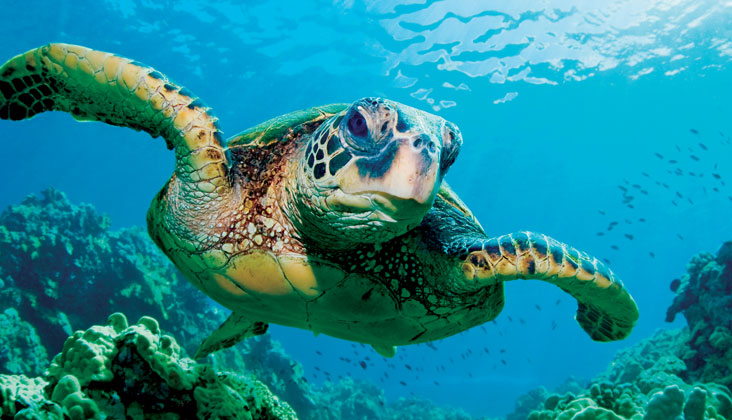
Ancient eyes watched me struggle to breathe through my snorkel. An immense shell blocked the sunlight filtering through the water and suddenly I was aware of the sea turtle floating close to me. I backed away from its penetrating gaze. Curiosity drew it closer, but I pushed away in obedience to the guide’s direction that we were not to touch the turtles. Hanging in the current, the creature was completely at ease, for it could stay under water for hours without going to the surface for air.

However this was my first snorkeling trip, and I still felt nervous trusting a narrow tube poking out a foot above the rocking waves to provide me with a consistent flow of oxygen. My breathing was rushed and desperate like a newly trained astronaut on their first mission. I remembered all the snorkelers we saw at the beach the day before, their faces in the water, barely moving their legs, arms at their sides. As my breathing slowed down, my body relaxed into the warm tropical water. I kicked farther away from the turtle and followed the other fins in front of me.

The underwater landscape was a peaceful change from the bumpy ride we endured on our Zodiac raft in route to the diving spot. Schools of black and yellow striped fish flowed around the coral reef with little effort. Turquoise and orange striped fish picked algae off the bottom. Tiny white fish streamed out of holes in the volcanic rock. In the distance I could see the massive shapes of other sea turtles, resting in the cradle of current. Pale grey fish, as large and as flat as dinner plates, swam right in front of my face. Streams of bubbles and chopping of swim fins provided the soundtrack to this alien world. My husband and the others in our group hung on the surface of the ocean, mesmerized by the abundance and variety of marine life.

Suddenly I sniffed up some water that had leaked into my mask and I lifted my head, choking on salt water. The waves lifted and dropped me roughly as I found it harder to breathe without the snorkel than when I had my head underwater. My stomach heaved and I got sick, unfortunately still with the snorkel in my mouth.

The guide that remained on the boat called out to me, “Are you alright?”

Not wanting to sound wimpy, I replied, “I am now!”

After rinsing out my snorkel, I replaced my mask and put my face back in the water. The churning ceased as I was back in the calm underwater world once more. This time it was easier to breathe, and I watched the show around me through the window of my mask. Time was suspended. There was no sense of the bustle of the air-breathing world above us. Fish grazed on the algae covered coral like brightly colored sheep. A grey fish with yellow fins and tail regarded me with disdain before swishing past my face. Turtles paddled to the surface for air and dropped back down into the depths.

Gradually I became aware that I didn’t see any other fins around me. Reluctantly, I lifted my head to see the rest of our group back on the raft. The guide waved at me, and I paddled toward her. It was time to return to the world of man.

The Almost Grand Canyon Trip

amboy

Our first Harley road trip to Arizona was full of storms. When the trip was planned for May, we weren’t expecting any rain. It was unfortunate we couldn’t have made arrangements to test new motorcycle gear, since we experienced every possible weather condition, short of a tornado. In spite of extreme weather, it was an adventure that built friendships and trust.

At 6:00 a.m., things are not as easy as later in the day. Frank and I were layered up with thermals, sweaters, leather chaps and jackets, with rain gear over it all. We never rode with rain gear before, which became immediately apparent when I tried to get on the bike behind Frank. My leg, which never had the range of a dancer to begin with, would not go over the bike. My husband, who has terminal anxiety about being late, looked over his shoulder to see why I was taking so much time. Finally with his help, I was seated, perhaps permanently.

We met up with the brave riders who ignored the weather reports, and Frank removed me from the bike. Feeling like a scarecrow, I peeled off the rain gear. The other riders assured us that rain would hold off so we didn’t need to worry about it until after the Mojave Desert portion of our ride. The ride captain had checked the weather reports for the towns we were passing through, and he was somewhat confident that we could make it through the day.

The first leg of our journey was a blur, not due to excessive speed but the blasting wind as we fought through to Yucca. But my head did not fall off, and we finally reached Twenty-Nine Palms and the desert.

The real kind with sand and no vegetation. Nothing but sand and asphalt.

The old Route 66 went through here, and I tried to imagine cars with no air conditioning crossing the massive emptiness. Then I thought about horses and wagons coming out to California for the gold rush. Were we as crazy as them?

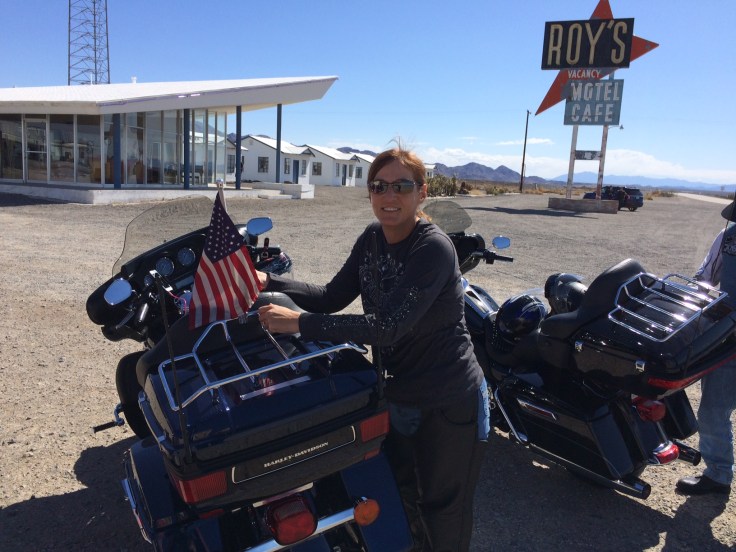
After nothing for miles, we stopped at an antique gas station in Amboy. Two pumps and some restrooms. A motel from the 60s era with a huge sign that said Roy’s welcomed us, but it didn’t look like anyone stayed there. We took a break in the bright sunshine, peeling off leather jackets and chaps.

Time that day was measured by gas station stops, the next one in Needles. The clouds that were threatening all day stretched above us like water balloons. The road captain consulted his phone for weather updates. We traveled a little while longer until we stopped underneath a freeway overpass. Leather and rain gear came back out, for we were headed up in altitude, towards Williams, Arizona.

Instead of taking the freeway, we continued to follow old Route 66 through wind-swept Native American reservations. Miles of scraggly bushes and cows stretched out in all directions. The mountains ahead were obscured by clouds. Bitter cold cross winds came up under our helmets and made our eyes water. Then the rain arrived as mist on our windshield.

As the line of bikes snaked its way across the rolling hills, rain caressed us gently, often mistaken as wind. Cold air pressed down on us as we rode directly through a low pressure cell. In the distance, I could see slivers of blue sky, but I couldn’t tell if our capricious road would loop away or toward the hanging clouds.

Onward we traveled down an endless road littered with the ruins of motels, gas stations, restaurants, and car repair shops that had closed up after the freeway had been built. Route 66 was a road through ghost towns, everything frozen in time.

Finally our road connected with the freeway which had killed it, and we stretched out on the wide, separated interstate that would lead us to our hotel in Williams. The mist continued to fall, but our rain gear did its job, and we stayed dry. The road captain threw up his arm to turn off, and we headed for the hotel. The rain had stopped when we arrived, and we went inside to check in.

Again Frank and I proved to be newbees as we tried to check in, and found our credit card cancelled. After a phone call, we found out that our frequent small purchases at gas stations along the way had created a fraud alert, which blocked our card. After we got that straightened out, we went outside to unload our luggage when it began to hail.

Huge gumball size ice balls pelted us as we grabbed our bags and headed for our room. However, by the time we were ready to walk down the street for dinner, the storm had stopped.

Our range of weather continued the next day as we rode to Flagstaff for breakfast. Instead of the relentless pelting of rain, we could barely feel the gentle caress of flakes. Our warm breath clouded the visors of our helmets and our fingers felt stiff. When we reached the restaurant, I realized I’d been holding my breath the whole time, praying that no one would skid out on the slippery road. But we made it to Cracker Barrel safely, and our troubles were forgotten with the help of coffee and pancakes.

During breakfast, the ride captain studied maps and conferred with his phone, weather again a concern. The Grand Canyon was at a higher elevation that included snow in the forecast.

After much deliberation and a vote from the group, we decided to take a scenic loop outside of Flagstaff that would head back toward Williams instead of proceeding to the Grand Canyon. As much as it was a disappointment, I was relieved that we were going to stay lower where we would face rain but not snow.

Our group rode into Flagstaff past the university and back out to the wilderness. The narrow two-lane road led us through woods and meadows, past ranches and houses that seemed like freckles on the huge expanse of land. Rarely did a vehicle pass us, and when it did, it was a Jeep or a four-wheel drive truck.

But the clouds had not forgotten us. A massive black one loomed to our right, a grey curtain of rain extended from its bottom. Would we make back to Williams before getting hit by a deluge?

On we rode and the road took us where it wanted us to go. The sky became more dramatic as sunshine hit us on our left. and the cold storm front pushed us from the other side. I felt like we were storm chasers, only without the protection of a van. Even if we stopped, there was nowhere to find shelter in the barren rolling land.

Suddenly, I felt a bucket of water dumped over my head. The storm had caught us! The ride captain slowed down as we were lost in a wall of rain. Only the yellow center line reassured us that we still followed the road. I shut my eyes for there was nothing to see. Surely we would stop somewhere and wait for the storm to pass.

But the road saved us as it turned to the left, away from the storm’s fury. We kept following it until it led us back to the freeway. Two short exits and we were back at the hotel, taking hot showers, and getting ready for dinner.

We all shared our stories that night. Some of us knew each other before the trip, but others, including us, were new. Some of it was more personal than the lunch conversations of a day trip. But riding through wind, heat, rain, sleet, and snow had changed our group. After surviving the storms together, we were ready to share the other storms of our lives as well.


Review of “The First Monday in May”

FMM

When I first saw the trailer for this documentary, I thought it would be just another reality T.V. show, with people tearing out their hair and swearing at each other. I had no idea that it was a love story.

“The First Monday in May,” directed by Andrew Rossi is a series of interviews and behind the scenes negotiations leading up to the 2015 New York Metropolitan Museum of Art’s Gala. The viewer gets to ride along with Andrew Bolton and Anna Wintour as they navigate the numerous decisions that will result in the Costume Institute’s exhibit “China Through the Looking Glass.” Anna Wintour is the dragon lady of this story, the real life inspiration for the book and movie The Devil Wears Prada. If the movie would have focused on her harsh decision-making character, it would have been difficult to watch. Instead, her infamous public image was downplayed, keeping the focus on the Gala.

As the movie unfolded, I was drawn into the romance between Andrew Bolton and his exhibit. As he interviews the designers who contributed costumes for the show, I could feel how captivated he was by his project. He hangs on every word from designers from Dior, Yves St. Laurent, and Chanel, gasping with delight as they display their creations. We follow the courtship between Andrew and his exhibit from Paris to Beijing. Chinese officials he meets show stone faces like overprotective fathers. But his words were passionate and pleading, ensuring their support.

As designers send their creations to the museum, every outfit is handled gently by workers with paper lab coats and latex gloves. Costumes were hung in sterile white closets like precious pieces of art. One of the most beautiful pieces was a long gold sequin dress with a train longer than any wedding dress I have seen. As the clothes were mounted onto abstract, faceless mannequins, they became alive.

The preparations for the Gala dinner seemed no different than wedding planning, as Anne’s assistants labored over the seating arrangements for celebrities and fashion industry giants. As the time grows closer, unforeseen problems with the lighting set the installation schedule back. In a reality series, this would have been the place where we saw the main character with his head in his hands, walking out the door, or screaming at the workers.

But this is the Met, and it is a love story. Andrew was willing to do whatever it takes to win his bride without complaint. His staff, the brides-maids and best men, work long hours to make Andrew’s vision come into reality.

At the unveiling of the show, the viewer gets to see some of the 50,000 costumes that were included in the “China Through the Looking Glass” exhibit. It starts with the wedding guests arriving on a red carpet, humming with the opulence of celebrities in designer dresses and tuxes. Beautiful women preen themselves before the cameras and reporters on their way up the stairs to the museum. Everywhere there is chaos of people laughing, drinking, and fake-hugging each other.

But we are allowed a more intimate view with Andrew as he walks alone through the completed exhibit, romantic music in the background. As the gowns glisten in the spotlights and pose against ancient Buddha statues, we can’t help but believe that his exhibit, his work of art, loves him back.

The Day I Became a Writer

SAMSUNG DIGITAL CAMERA


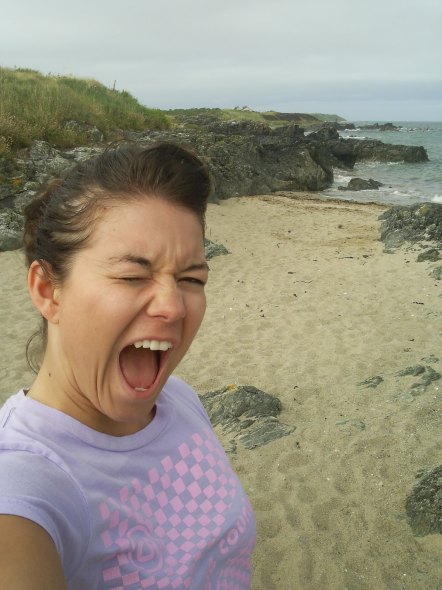
I became a writer one day in Ireland, standing on slime covered rocks squinting over at France. Actually I had written many stories during the course of my forty years, but that windy beach changed me.

My daughter, Kristin, and I were five days into an eleven day quest through Scotland and Ireland. I was collecting research on castles for a book, and I liked seeing them in person more than looking at pictures on the internet. Earlier that week, we had toured Edinburgh Castle, and were now driving through the back roads of Ireland on our way to Blarney Castle.

I had rented a car in Dublin with the encouragement of our travel agent who assured me I would quickly learn how to drive a left handed stick shift on the opposite side of the road. How lost could you really get on an island? The day I picked up the car, Kristin and I learned the answer for over two hours before accidently passing our hotel, thanks to the one way streets and tiny street signs that were tacked to the sixth floor of the brick buildings at every major intersection. After a moment’s embarrassment at the front desk when I learned they were about reading to send out the Gardai to find us, I consoled myself that driving in the country would be much easier.

With the July sun shining in our faces, we headed down the east coast toward Rosslare Harbor, where we had plans to stay at a dairy farm that was also a bed and breakfast inn.  Still feeling the sting of yesterday’s mistake, I made Kristin official navigator. She carefully studied the map, which was twice as interesting since the town names were both in Gaelic and in English. We managed well until we reached the roundabout outside of town. Turning right into the circle of cars, it was the merry-go-round on the playground all over again. I merged into the spinning swirl of cars until we jumped out onto the road I thought would lead us to the dairy farm.

The other difficulty about driving in Ireland is that once you are on a road there are no road signs to reassure you that you are indeed on the correct road. Only when you arrive, an hour later, at the next medieval town do you realize that you should have stayed on the roundabout one spoke farther to the right. Since this was before phone navigation, we stopped at the only place you could ask directions – the pub.

Forty five minutes later, after we had shared stories with the old men who seemed to live at the pub, we were headed in the right direction. When we finally passed the old oak tree, turned right at the corner where the white cows stand, and turned left at the golf course, we ended up at our destination. A two story brick and wood house with a tall chimney, surrounded by barns and other buildings popped up between the hills.

After sipping tea with our hostess, Kristin and I decided to stretch our legs by walking to the beach. We followed the low stone wall all the way to the end, as instructed, passing black and white cows and sheep with pink spray painted on their rear legs. A narrow dirt path led us through waving tall grass, between randomly tossed chunks of rock, until we came out to a deserted beach.

Waves crashed over slippery black rocks, creating fountains of spray. We climbed out on the rocks as far as we dared, braving the icy spray carried in the breeze. Looking out to sea, we could see the outlines of cruise ships and cargo ships on their way to Europe.

“Ireland!” Kristin yelled over the crashing surf. Here we were, around the world from California, standing on the beach of the land that birthed many writers. They were my ancestors, and I had come home.

At this point in my life, my identity had been shaken. I was no longer a wife. My husband’s relatives and friends had faded away in grief. My career in retail buying had been swept away, and replaced by a career in teaching. My children were growing up and independent, leaving me with empty time. Time to write.

Standing there on that slippery rock, in the land of my ancestors, I suddenly knew that I was a writer.


Dancing with Mountains

Ortega

As our HOG chapter roared down the narrow road that paralleled Lake Matthews, the sky was bright with promises of cool spring weather. After previous days of thunderstorms, this blue sky only held wispy feather clouds, incapable of interfering with our ride. My husband and I were riding almost in the middle of the pack, with eight riders ahead of us and nine behind. Before we had left the dealership, the road captain had called for two sweeps, one that rode directly behind us and one at the back of the group, in case we were separated by traffic lights. He also reminded us that if we had difficulty and had to pull off, the sweep would stay with us until help arrived.

Such dire thoughts vanished from our minds as we followed the back roads down to Ortega Highway. As we turned onto the road, Lake Elsinore at our back, I looked up at the imposing ridge before us. I could see tiny cars moving in layers of road that switch backed on the desert side of the mountain. The pack spread out from its staggered formation to single, causing the group to stretch out past my line of vision.

That’s where the dance began. Through the twisted turns, our Harley obediently leaned to the left, straightened out, and then leaned to the right. The pattern had a rhythm that mesmerized me. The mountain had accepted our request for a dance, and he was leading us through the steps. On and on he led us to the beat of unheard music, over the top of the rugged mountains and into the shade of a small mountain community. We rode straight through a canopy of trees for a short time until we started down the other side of the pass.

Here the dancers dangled from the edge of a canyon, the road clinging to its side. Sometimes we were interrupted by an impatient sport bike that rushed past us, unwilling to join our dance down the mountain. Still we danced– riding the left turn, straightening out, and then riding the right turn. As the dance continued, I readjusted my position slightly, feeling like a human caught up in an endless faery reel.

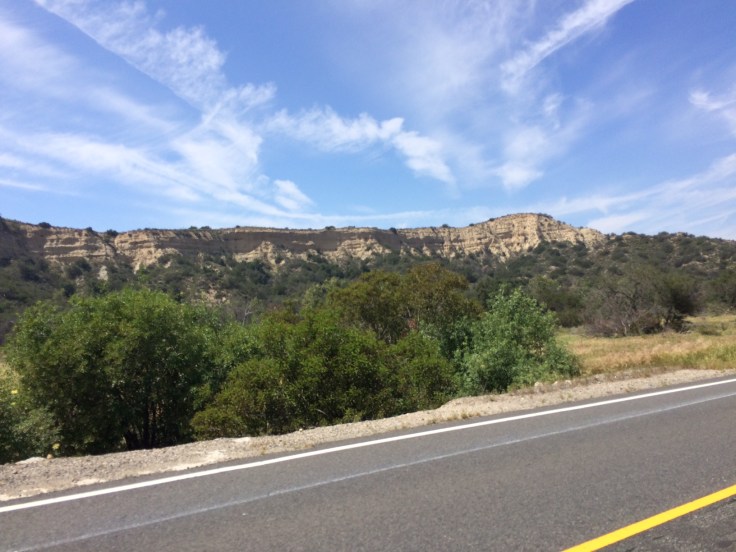
Suddenly, the road shot out straight, and neighborhoods replaced rocky cliffs. We roared to a stop at the traffic light, shaking out shoulders, taking a deep breath. The group bunched back up into two across, sharing about the ride with smiles that peeked out under their helmets. I turned around and snapped a picture of the glistening white canyon behind us. Even though I felt like I had held my breath for the past forty minutes, I couldn’t help smiling with the rest. Good bye for now, and thank you for the dance.

Back Roads to Pioneertown

Pioneertown

(Photo by Kevin Austin)

When we rolled out of the Riverside dealership that morning, most of the HOGs were still yawning. Daylight Savings Time had just arrived, and we regretted that lost hour of sleep. The sky was gradually brightening with the promise of a sunny day. Two by two the Harleys lined up at the traffic light, their snarling engines ready to run. When the light turned, we poured onto the freeway, fitting ourselves into the jigsaw puzzle of traffic.

We rode in small clumps at first, eighteen bikes too many to stay together between cars. Eventually open space allowed us to line up in staggered formation as we endured the mindless repetition of on ramps and off ramps, merging traffic and slow trucks, road construction and reckless drivers. Cloud topped mountains drew closer, looking like brownies covered with whipped crème. Frozen whipped crème. Shivering, I zipped up my heavy leather jacket and pulled the collar of my layering jacket over my chin. Promised sunshine now hid away, and the threat of icy rain loomed over us.

Hand signals rippled down the line of bikes as we threaded through traffic toward our exit. At the end of the ramp we paused, free from the chaotic energy of the freeway. One by one the pack turned onto a narrow winding road that carved through the mountains toward the high desert valleys. The road hugged the sides of rippling hills like the zigzag stitch on a blanket. The long procession of bikes spread over the hills into the distance. To the north I could see layers of mountains like bookshelves, the next shelf up holding a slow moving freight train, and the top shelf the frantic vehicles on the freeway beyond our exit.

Our journey changed drastically. We fell into the rhythm of curves and dips as we traveled through land that was unconcerned about man’s ambitions. Water carved red rock hills covered with bristly bushes chased each other into the distance. A sheer rock wall watched us from the left with a lofty arrogance. These rocks existed when the Native American tribes roamed over them on horseback, and they would still stand after our passing. The twisty roads forced us to ride slowly, slowing our pulses, slowing down time. Bike following bike, the road leading us on.

Suddenly the road spit us out into a wide flat valley and straightened itself out. The Harleys gladly stretched their legs and gained speed. Gradually I grew aware that the ominous grey wall of mountains on our left was growing closer as we rode. As I looked behind and ahead of us, I could see no end to it. Yet our road seemed determined to connect with it. How would we get over it? Would the road lift us to the top of that wall or would man’s determination have tunneled through it?

Miles sped by in our race to the wall, and soon I could see the end. The wall sloped down before it merged with another ridge, and into this opening the road stretched through. The bikes climbed over it without strain, and dropped down into another flat valley. The mountain peaks on our right were dusted with snow, and I knew that on the other side, snow boarders were riding rails and practicing jumps in the fresh powder. However this side held dry cracked rocks and joshua trees reaching toward the bright blue sky. Water in this valley had to be trapped by high dams like the one we just passed.

The road passed through white fenced ranches that eventually led into small groups of houses and buildings, towns so small they seemed out of place in overpopulated southern California. A man in his electric wheelchair rumbled on the dirt shoulder. Where he was headed on a straight narrow road with no sidewalks I couldn’t guess, but I admired his perseverance. The line of bikes pulled into a gas station, and we stretched our legs and gulped some water. Although it was not hot, the air was so dry it crackled.

After a brief rest, we roared on our way toward our goal. After passing through miles and miles of caked dirt dotted with brush and more spiky joshua trees, the land surrounding us smoothed out into a huge flat area with no vegetation, a dry lake bed. I wondered what happened to the water—was it diverted for other purposes, or did it simply dry up over time? It felt like a lunar landscape had fallen into our path.

The road called us on, and we descended into another valley, this one much hotter and dryer than the last. Pink desert mountains lined the horizon on the left. A line of buildings in the distance slowly grew into our lunch stop. Wooden buildings, including a saloon front, saddle shop, and a jail, formed the skeleton of an old western movie set, now a tourist attraction and motorcycle destination. We pulled into the dirt parking lot and parked the bikes in a row, just like cowboys would have tied up their horses in front of the saloon. I carefully dismounted our Harley, stiff muscles protesting. We all took off our helmets and layers of jackets and leather chaps. Even though we had just ridden over twisting roads and through dry dusty towns, we were excited to share our journey together. It was time for food and drink, tales and jokes, friendships forged in adventure.

The College of the Crones Chp 2

mask

Chapter Two Part One- Masquerade Ball

Although there were nightly parties at the prince’s castle, everyone’s favorite event was the harvest festival masquerade ball.  All the landowners and townspeople came dressed in elaborate and often ridiculous costumes.  The prince savored a sip of Eldertown’s best red wine, as he pictured the party guests. For most of my subjects the foolish apparel is an improvement. Except for the ladies, of course. At least the ladies, thanks to his beauty potion, did not offend his sensibilities. He downed the rest of his goblet.

All the preparations were complete for the masquerade ball. But of course all is ready. I will not tolerate anything less than perfect. Hours of labor had produced a glossy shine on the tile floors. The entire castle had been decked with garlands of ivy and blood red roses. From the kitchen came a whirlwind of noise and aromas, escalating as the hour of the guests’ arrival approached. The band was tuning their instruments. Court ladies reclined in their dressing rooms, allowing their servants and handmaidens to add last minute details to their costumes. All the lanterns and chandeliers had been lit. The castle glistened like a giant star upon the hill. Since it was the end of the harvest season and winter was approaching, it was already quite dark and crispy cool. It was the perfect night for a ball.

Away from the clatter of preparation, the prince relaxed in his sitting room, his chair facing a crackling fire in a massive stone fireplace. The fireplaces were always roaring in his private rooms. All the changing seasons in this world are quite unsettling. He was always layered in fine wool and furs after the leaves began to turn fiery orange and red. His shivering wouldn’t cease until springtime warmed his face once more.

The gold trimmed mirror over the mantle was tipped to catch his reflection. He couldn’t help noticing the way his wavy black hair caught the glint of the firelight, and how his neatly trimmed beard accented his piercing green eyes and prominent nose. No man in this world can captivate hearts the way I can.

            Still, he was too thin, despite his feasting, and not as tall as he would have liked. His narrow pointed ears he kept hidden under his hair. He didn’t need to draw attention to the few differences between mortals and faeries. His people thought his never-ending youth was due to another potion that he kept for himself. If they discovered I was a faerie, they wouldn’t be so eager to trust me.

Looking Back at 2015

working

Part of being a good teacher is the ability to reflect and respond. After the kids leave, and you’re sitting in a mess of broken crayons, glue-crusted desks, and overflowing trash cans, it’s time to go over all the lessons that day. “I’ll never do that again!” and “Wow! I can’t believe that worked!” are the thoughts that guide me for future instruction.

But I can’t help being that lifelong learner when I go home. And now it’s New Year’s Eve, and time to clean up the mess and plan for next year.

My husband and I have been going on a planning weekend in January for the past seven years we’ve been married. Besides spending quality alone time together, we have a notebook that we use every year. We go over the goals from the past few years and evaluate our progress toward them. Some ideas make us laugh as they aren’t even concerns anymore. Others make us groan as we realize we didn’t do anything about them.

At the end of December, I have enough free time to start thinking about what I will add to our notebook this year. And to prepare my defense for those goals I didn’t reach.

Financial goals always make me cringe, but this year I want to save more money. I really bombed on this one last year, but my attitude toward spending has evolved. It’s amazing how much stuff you don’t need as you get older. Well, maybe except my phone and computer. And wifi.

In the category of personal goals, 2015 was going to be the year I reached out with my writing. A writing friend suggested joining The Society of Children’s Book Writers and Illustrators. When I finally did, I had the opportunity to meet with an agent and have professional editing at a writing conference. In addition, I met some great creatives and listened to their stories of being published in the traditional way. But this group doesn’t meet often, so I found The California Writers Club online. The Inland Empire Branch meets monthly in Ontario so I could quench my thirst for literary conversation and learn more about self-publishing and promotion. Both groups helped me communicate my stories in a more confident and professional manner.

Still questing for additional critique of my almost completed book The College of the Crones, I decided to go back to college—University of California Riverside Extension Program. In September I started working on my Fiction Writing Certificate, a 20 unit program to shore up the structure of my writing. Writing definitely stays on the list for 2016.

In the category of shared goals, my husband and I joined the Harley Owners Group in November, after agonizing about it for over a year. Originally we had wanted to start our own motorcycle riding group, but after wise counsel, we decided to see how it was done first. It has been a great adventure, riding the back roads and starting new friendships. We also started riding with The Black Sheep, a Christian motorcycle ministry. Much to our surprise, the HOGs were much tamer than the Black Sheep. But that’s another blog. It will be interesting to see how the miles will add up this year.

As the hours tick down to 2016, I find myself at peace. There were some events I regret, but mostly it has been a year of growth. Each day is a learning experience, and as long as I remain teachable, the coming year will provide many opportunities to shape my life.


A Perfect Day

working

The 5:10 a.m. alarm wasn’t as shrill as most Mondays. Instead of stretching out my back and doing some twists in bed before my feet hit the floor, I jump up and out to the kitchen to turn on the coffee. Aside from the whispering dream of walking all the way into the mountains to visit my grandkids (Where does that come from?), my mind is as clear as a desert sky. It’s going to be a perfect day.

I’m busy constructing my husband’s lunch as he emerges from the bathroom. His ham and cheese sandwich looks more purposeful than usual. I even remembered the mayonnaise today. This morning, I even take time to make peanut butter celery sticks. My husband looks awake and ready for his forty-five minute commute to Murrieta.  He watches me curiously as I wrap them in foil.

“Why didn’t you stay in bed? I could have made my lunch this morning,” he says while wrapping me in a hug.

“I needed to get up,” I insist. “It’s going to be a perfect day.”

He nods with the understanding he alone has of the innermost workings of my mind. After pouring his coffee into his travel mug, and thermos for later, he gathers up his lunch and keys, kisses me, and heads out the door.

My day begins with devotion and meditation time. This involves a stack of pillows, a fleece blanket, a steaming bowl sized cup of coffee, and my Bible. Time to mentally and spiritually prepare for the day.

Some time passes, and I don’t look at the antique clock on the mantle once. This is a perfect day, and I don’t care about watching the time. When I’m ready, I unwrap myself from the couch and head into the kitchen. Instead of a quick bowl of instant oatmeal, I make myself an egg on an English muffin. I can nibble it slowly while I check social media on my phone. The sandwich actually has time enough to cool before I finish it, but this doesn’t annoy me because it’s going to be a perfect day.

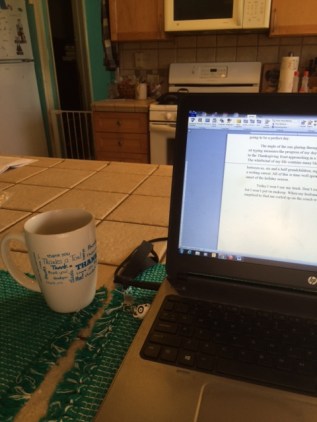
Clean up can wait, and it’s time to plug in my lap top. I haven’t made a To Do List, but I’m not worried. Today I can post on my blog, do revisions on my book, and anything else I feel like doing. I might even watch a movie. Or maybe even DO NOTHING. The scandal of this thought causes me to shudder, but the moment passes quickly as I open up my computer. It’s going to be a perfect day.

The angle of the sun glaring through my kitchen window onto the breakfast bar where I sit typing measures the progress of my day. I write and drink coffee; I plan out my contribution to the Thanksgiving feast approaching in a few days. I pause to consider my own thankfulness. The whirlwind of my life contains many blessings- a husband-friend-partner, six children between us, six and a half grandchildren, supportive family, a teaching career, and the pursuit of a writing career. All of this is time well spent, but I do enjoy my vacation days, especially at the onset of the holiday season.

Today I won’t use my truck. Don’t expect me to call or text you. I might brush my hair, but I won’t put on makeup. When my husband returns at the end of the day, he won’t be surprised to find me curled up on the couch with my Kindle. After all, it’s a perfect day.


The Dragon of Doubt

The hardest part of being an unpublished writer is the doubt. Even though you may try to surround yourself with your companions (spouse, coworkers, friends, writing groups) eventually you must face it alone.

A writer must be as brave as a knight on a quest. Stories are adventures, but the greatest adventures contain dragons and trolls. That’s why writers wear armor and carry big swords. Every time I sit down at my computer, I am ready to do battle.

In the middle of an early chapter, a huge Doubt Dragon swoops down on me. “Hey, I’m trying to work here!” is the sharp edge of my sword that bounces off the dragon’s diamond scales. “But you’ve never published the first book! You’re wasting your time!” the creature roars, its fiery breath scorching my cheek with truth.

Desperately, I glance down at my armor for strength. The plays I’ve written and performed for over 1,100 children are reflected in my breastplate. The chain mail peeking out from the joints remind me that my story is worthy. My helmet whispers that my story must be told, in my way.

The Dragon regards me with hesitation. I have not fled in terror. I cannot. For I have not chosen to be a writer- writing has chosen me. With renewed strength, I thrust my sword once more, this time piercing the creature’s critical eye. With a piercing scream, the Dragon beats its wings raggedly and flies away.

Victorious once again, I return to my work. After I clean my weapon, of course.

dragon

Blog at WordPress.com.

Up ↑